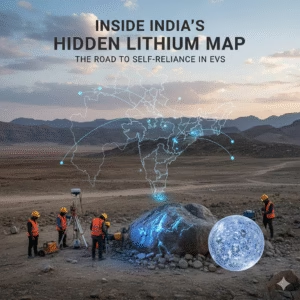
India’s electric vehicle ambitions may soon rest on one element hidden beneath its soil – lithium. Often called the “white gold” of clean energy, lithium is vital for making EV batteries and energy storage systems. For a country pushing toward clean mobility, discovering domestic lithium could transform not just its auto industry but its strategic energy independence.
The Geological Survey of India has reported an inferred resource of about 5.9 million tonnes of lithium in the Salal-Haimana area of Reasi district, Jammu and Kashmir. The word “inferred” matters: it confirms presence but not yet extractable quality or economic feasibility. Still, this marks India’s biggest step yet toward securing its own lithium supply.
Beyond Reasi, early exploration points to promising zones in Rajasthan, Chhattisgarh, Odisha, Andhra Pradesh, and Gujarat. Rajasthan’s Nagaur-Degana region is attracting particular attention for its mica belts rich in lithium traces, while Gujarat’s Rann of Kachchh may hold brine-based deposits similar to those in Chile and Argentina. If validated, these discoveries could place India among the world’s top lithium-rich nations within the next decade.
Yet optimism must be balanced with caution. India’s lithium deposits are mostly in hard-rock formations, not in easy-to-process brine. Extracting from rock requires complex, energy-intensive methods, raising both cost and environmental risk. Mining in delicate Himalayan and desert ecosystems adds another layer of concern over water use, habitat loss, and community impact.
Even if the lithium is mined successfully, India still lacks refining capacity. The country imports almost all of its lithium compounds and battery materials, meaning any locally mined ore may still need to be exported for processing. That dependence undermines the very self-reliance policymakers are seeking.
Investor confidence is another issue. Government auctions for lithium blocks have drawn lukewarm participation due to uncertainty around reserve quality, environmental norms, and transparency in exploration data. Without clear policy signals and infrastructure incentives, large-scale investment may remain slow.
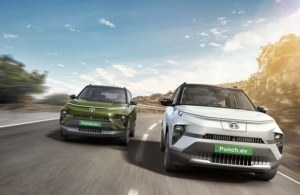
Still, the potential prize is enormous. For India’s auto industry – one of the largest in the world – local lithium production could slash EV battery costs by up to 25 percent in coming years. That would make electric cars and two-wheelers far more affordable, fueling adoption across the mass market. It could also generate new manufacturing clusters for refining, cell production, and recycling, creating thousands of jobs in mineral-rich regions.
The government has already declared lithium a “critical mineral,” updating mining rules and offering incentives for battery manufacturing. But experts warn that discovering lithium is just step one; building the full ecosystem – from refining to cell assembly and recycling – will define whether India becomes an EV powerhouse or stays dependent on imports.
Globally, India is still far behind leaders like Australia, Chile, and China in lithium production and processing. Yet its combination of growing EV demand, mineral potential, and strong industrial base gives it a rare chance to catch up. If managed responsibly and with environmental safeguards, India’s hidden lithium map could shift the balance of global supply chains – and perhaps power the next generation of Indian-made EVs.
The road from exploration to extraction will not be easy, but it is strategically vital. For the auto sector, the next five years will determine whether India emerges as a genuine player in the global EV race or remains on the sidelines, importing the very materials that drive its green transition.