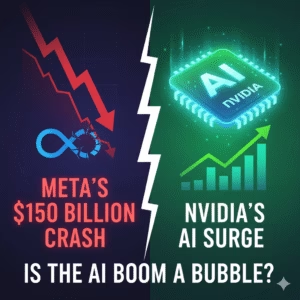
Meta Platforms’ stock plunged more than 11 percent this week, wiping out roughly $150 billion in market value after the company warned of soaring expenses linked to its artificial intelligence investments.
The fall — Meta’s sharpest since 2022 — has rippled across the tech sector and ignited a debate that’s been quietly building for months: Is the AI gold rush overheating?
Meta’s record revenue, but rising risk
On paper, Meta’s results looked strong: $51.2 billion in quarterly revenue, up 26 percent year over year. But earnings per share collapsed to $1.05, far below expectations, after a $15.9 billion tax charge tied to U.S. policy changes.
Investors were further rattled when the company lifted its 2025 capital-expenditure forecast to $70–72 billion, with even higher spending planned for 2026. Most of that will go toward data centers, GPUs, and AI infrastructure — what CEO Mark Zuckerberg calls “building the backbone of the next computing era.”
The market’s verdict was harsh. Meta shares fell double-digits overnight, and sentiment quickly spilled over to NVIDIA, Alphabet, and Amazon — all major players in the AI supply chain.
A warning from the data: hype is catching up with reality
The Bank of England recently cautioned that AI-linked valuations “rival the extremes of the dot-com bubble,” warning that a global correction could follow if investor optimism sours.
The International Monetary Fund echoed that view, saying financial markets may be “pricing in AI’s potential faster than its proven productivity.”
At the World Economic Forum in Davos, Gita Gopinath, the IMF’s First Deputy Managing Director, said AI is “a double-edged sword.” While it could supercharge productivity, she warned that up to 12 percent of India’s workforce could face displacement.
She also urged policymakers to focus on “investing smartly, not blindly,” emphasizing that the world must prepare for AI’s economic shocks just as much as its benefits.
At the AI for Good Summit, Gopinath put it bluntly: “If mismanaged, AI could turn an ordinary downturn into a deep and prolonged crisis.”
NVIDIA: the new symbol of AI exuberance
If Meta’s earnings miss revealed cracks in AI spending, NVIDIA’s rise has become the poster child for how stretched valuations have become.
The chipmaker’s market capitalization recently crossed $3 trillion, briefly making it the world’s second-most valuable company — ahead of Apple — despite annual revenue of just about $120 billion.
To put that in perspective:
- NVIDIA’s market value equals roughly 10 percent of U.S. GDP, a figure analysts describe as “bizarre.”
- Its price-to-sales ratio exceeds 25, compared with 3–5 for typical hardware companies.
- Analysts at JPMorgan and Barclays have begun flagging the company as “priced for perfection”, meaning even a minor earnings miss could erase hundreds of billions in valuation.
“AI is real, but markets are treating it like magic,” said Paul Donovan, chief economist at UBS. “When a chipmaker’s market cap is measured in GDP terms, something’s off.”
Still, NVIDIA’s defenders argue that the company sits at the very core of the AI revolution — its chips power nearly every major model and data-center build worldwide. The company’s rapid profit growth — from $4 billion in 2021 to over $60 billion expected this year — keeps bulls convinced it can grow into its valuation.
But Meta’s stumble shows what happens when AI spending starts to exceed near-term returns — and NVIDIA, as the biggest beneficiary of that spending, can’t ignore that risk.
From “blank check” to “prove-it” phase
For the past two years, markets rewarded any company that said “AI.” Now, they’re demanding receipts.
“The AI boom isn’t ending,” said Ben Thompson, tech strategist and author of Stratechery. “It’s maturing. Investors are moving from blind faith to business fundamentals.”
Even optimists like Gartner’s Arun Chandrasekaran believe this is a healthy correction. “This is where hype turns into hard economics,” he said. “AI will change everything — just not at the pace investors are pricing in.”
What happens next
If the correction deepens, three shifts are likely:
- Capital discipline: Big Tech firms could scale back AI infrastructure spending or stretch project timelines until returns become visible.
- Profit focus: Investors may rotate into companies already monetizing AI — like Microsoft’s Copilot or Amazon’s Bedrock cloud tools.
- Policy pressure: Economists like Gita Gopinath are calling for new frameworks on AI investment, workforce reskilling, and transparency to prevent over-concentration of risk.
In other words, the next AI boom will be judged not by imagination, but by execution.
The bigger picture
Meta’s $150 billion wipeout isn’t just a corporate headline — it’s a signal that the AI narrative may finally be colliding with economic gravity.
The technology is transformative; the expectations are explosive. Somewhere in between lies the truth.
As one London-based fund manager summed it up: “AI isn’t a bubble yet — but the air’s getting thin. Meta just reminded everyone to breathe smarter.”