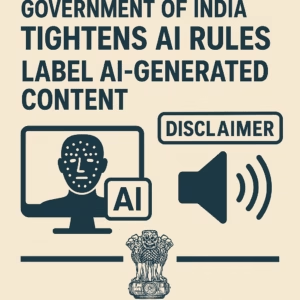
The Government of India has proposed sweeping new regulations to label AI-generated content — from synthetic voices to deepfake visuals — citing the growing risk that artificial intelligence could be used to spread misinformation, manipulate public opinion, and even incite unrest.
The proposed amendments to the country’s IT rules would make it mandatory for creators and platforms to clearly label AI-generated content, ensuring users can distinguish between real and synthetic media. The draft mandates that AI-generated visuals carry visible labels covering a portion of the image and that synthetic audio be prefaced with an explicit disclaimer.
Officials say the move follows rising global alarm over the use of AI in creating political deepfakes, manufacturing consent, and triggering civil unrest — incidents that have already reshaped political outcomes in several countries. Governments worldwide have warned that deepfake-driven narratives could erode public trust, spread panic, or even contribute to engineered “regime change” scenarios by faking statements from leaders or institutions.
Why the Government Is Moving Now
India currently lacks a single, comprehensive AI law. Instead, it relies on a web of existing laws such as the Digital Personal Data Protection Act (DPDP) 2023 and sector-specific rules. However, with deepfakes and synthetic media rising sharply, the Government of India sees an urgent need to plug regulatory gaps.
The Ministry of Electronics and Information Technology (MeitY) has proposed a risk-based classification of AI systems — treating those used in sectors like finance, healthcare, and governance as “high-risk,” subject to stricter oversight. The rules aim to ensure accountability, transparency, and human oversight, especially when AI systems could influence public safety or civic stability.
What It Means for Creators
For digital creators, YouTubers, and small businesses using AI tools — particularly synthetic voice and image generators — the new rules carry real implications.
- Label everything AI-generated: Platforms may soon require creators to mark AI-produced visuals and audio, even in entertainment or commentary content.
- Be cautious with likenesses: Using voices or images resembling real people without consent could invite penalties.
- Keep records: The draft proposes that metadata and logs of AI-generated content be preserved for potential audits.
- Sector sensitivity matters: AI used for advice in finance, health, or governance will likely face tighter scrutiny.
While the Government of India insists the intent is not to stifle innovation, creators worry about compliance burdens and fear smaller teams might struggle to keep up with documentation demands.
A Global Security Context
Across the world, AI-generated propaganda and deepfakes have already destabilized political landscapes. In Eastern Europe and the Middle East, fake videos have been circulated to simulate war crimes, fuel ethnic tensions, and sway elections. Western intelligence agencies have also flagged synthetic media campaigns aimed at creating confusion and undermining institutions.
The Government of India is watching these trends closely. With the 2026 general elections approaching, officials are keen to preempt similar misuse in the Indian context — where misinformation can travel at viral speeds across multiple languages and platforms.
A senior policy official said the labeling mandate is as much about national security and civic integrity as it is about transparency. “We are not just talking about fake memes or entertainment videos. The potential for deepfakes to ignite unrest or delegitimize institutions is a real and present risk,” the official noted.
How Other Countries Are Responding
India’s draft aligns with a global trend toward regulating AI accountability and transparency.
- European Union: The EU’s AI Act classifies AI systems by risk and mandates strict obligations for “high-risk” uses like biometric surveillance and credit scoring.
- United States: The U.S. follows a sector-based model, with federal agencies issuing AI safety and transparency standards through executive orders.
- China: China mandates labeling of all AI-generated content and requires AI providers to register algorithms with regulators.
- United Kingdom: The UK promotes innovation-first regulation while assigning AI oversight to existing sector regulators.
- Singapore and Japan: Both nations emphasize human-centric AI, encouraging voluntary codes of conduct and sandbox frameworks for trusted systems.
By proposing content labeling and accountability mechanisms, the Government of India is effectively combining the EU’s risk-based model with China’s transparency-first approach, while maintaining flexibility for innovation.
Expected Timeline for Rollout
The draft rules were released in late October 2025 for public consultation, with feedback open until early November. After review and revisions, the final version is expected to be notified by the end of 2025.
Experts anticipate a 6–12 month transition period, meaning platforms and creators could see mandatory compliance starting around mid to late 2026. Larger platforms may face shorter deadlines, while smaller creators are likely to receive additional time for adjustment.
While these dates are still estimates, the Government of India is expected to prioritize enforcement before the 2026 general elections to curb potential misuse of AI-generated content in political communication.
What Comes Next
The Government of India is also preparing broader AI governance guidelines that define risk categories, developer obligations, and mechanisms for periodic audits.
Meanwhile, the Reserve Bank of India has drafted a framework for responsible AI use in finance — focusing on auditability and algorithmic transparency — underscoring the coordinated, cross-sectoral nature of the country’s approach.
For now, MeitY’s proposed content-labeling standards are being seen as a cornerstone of India’s emerging AI regulatory framework.
The Bottom Line
The Government of India’s draft AI rules mark a turning point: they’re not just about protecting data or preventing spam — they’re about safeguarding democracy and public order in an era where reality itself can be fabricated.
For creators and startups, the safest path forward is to embrace transparency-by-design — label synthetic content, maintain consent records, and stay informed as India’s AI policy framework takes shape.