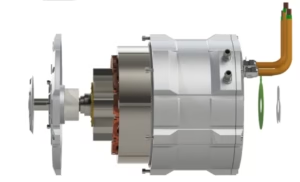
In a strategic move to reduce dependency on China and secure its clean energy future, the Indian government is urging automakers and electric vehicle (EV) manufacturers to develop rare-earth-free technologies for motors and batteries. The directive aims to strengthen India’s self-reliance in critical minerals while promoting sustainable manufacturing.
The Ministry of Heavy Industries and NITI Aayog are collaborating with industry leaders and research institutions to identify viable alternatives to rare earth elements such as neodymium, dysprosium, and terbium, which are widely used in EV motors and wind turbines. These materials are currently dominated by Chinese suppliers, creating vulnerabilities in the global supply chain.
According to officials, India plans to fund pilot projects and innovation challenges for companies that can design motors based on ferrite magnets or other non-rare-earth materials. The move aligns with the country’s “Atmanirbhar Bharat” (self-reliant India) mission and the FAME-III policy, which is expected to roll out incentives for green and locally sourced technologies in 2026.
Industry experts believe this policy push could reshape India’s EV ecosystem. “Developing indigenous alternatives to rare earths could make India a global leader in affordable and sustainable mobility,” said an auto industry executive involved in early discussions.
However, analysts caution that shifting away from rare earths will take time. The global auto industry has invested billions in permanent magnet motors, and alternatives like switched reluctance or induction motors still face performance and efficiency challenges. Yet, India’s large domestic market and growing R&D capacity provide the scale needed to make such innovation viable.
The government’s focus on rare-earth-free tech also aligns with its broader environmental goals under the National Electric Mobility Mission Plan and Energy Transition Strategy, targeting net-zero emissions by 2070. By reducing import dependence and promoting local innovation, India aims to position itself as a key player in next-generation clean technology manufacturing.