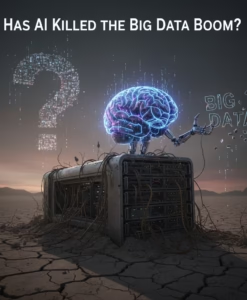
The era when the buzz was all about collecting vast amounts of data — the so-called Big Data boom — has evolved into a new age powered by artificial intelligence. Rather than signalling the death of Big Data, AI has given it a sharper and more meaningful purpose.
Between 2010 and 2016, companies raced to gather as much information as possible — clicks, transactions, videos, sensor data, and anything that could reveal insights. The assumption was simple: more data meant more value. But there was always one missing link — what to actually do with it.
Now, AI acts as the engine that turns this massive data reservoir into something useful. The question is no longer “How much data can we store?” but “What can we do with it?” Big Data provides the raw material; AI drives the analysis, prediction, and automation.
In industries like finance, this shift is transforming how institutions work. Banks still collect millions of transactions every day, but AI now analyses them in real time — detecting fraud, predicting loan defaults, and even tailoring credit offers. Big Data fuels the process; AI converts it into actionable intelligence.
The Shift That Changed Everything
This transformation reflects how technology itself has matured. The focus has moved from storage and scale to intelligence and speed. Real-time data processing, edge computing, and AI-driven analytics have become the new normal. The world’s data production continues to explode, but its value lies in how intelligently it’s used — not in how much is stored.
By 2012, experts declared the beginning of the “Zettabyte Era,” when the total amount of data stored worldwide crossed one trillion gigabytes. That milestone marked the height of the Big Data age. But while the storage race has slowed, the intelligence race has only accelerated.
Living in the Intelligence Era
If Big Data was the fuel, AI is the engine. The fuel alone is inert unless it powers something. In today’s digital economy, storing petabytes of data is no longer enough; companies must deploy AI to extract value and insights.
Consider retail: a chain may collect millions of data points from customer purchases, loyalty cards, and IoT sensors. That’s Big Data. But when AI models are layered on top, the retailer can predict buying patterns, optimise inventory in real time, detect anomalies, and automate marketing strategies. The data becomes not just a record — but a revenue driver.
What Businesses Must Do Next
For modern enterprises, the challenge is no longer volume but velocity and value. They must shift focus from “how much data” to “how fast, how accurate, and how actionable.” AI depends on high-quality, well-organised data rather than sheer quantity.
Legacy Big Data systems were built to store and archive information. Today’s systems are built to process, learn, and decide. Real-time pipelines, automation, and decision-centric architectures are taking center stage. Yet challenges remain — from ensuring data security and governance to managing the massive infrastructure demands of AI models.
Still, the message is clear: businesses that merge AI and data strategy will outperform those that treat them as separate worlds.
Bottom Line
So, did AI kill the Big Data boom? Not at all — it elevated it. The Big Data era laid the groundwork by teaching the world to collect everything. The AI era refines that mission by helping us make sense of it all. Big Data collected the information. AI turned it into intelligence. And in this new intelligence era, success belongs to those who know how to turn data into decisions.