OpenAI is under scrutiny after its chief financial officer, Sarah Friar, suggested that U.S. government loan guarantees could help fund the company’s large-scale AI infrastructure projects. The comment sparked immediate backlash and prompted CEO Sam Altman to step in with a detailed clarification. Friar’s statement implied that federal backing might reduce financing costs for building advanced data centers and chip facilities. Critics argued that such support could signal reliance on taxpayer funds for private ventures. Friar soon clarified that her comments were misconstrued. However, the damage was already done.
Within hours, Altman stepped in, saying OpenAI has not requested and does not intend to seek government guarantees. He explained that the company’s discussions with policymakers have focused on semiconductor supply and not on public financing. Altman added that taxpayers should not be responsible for private companies’ business risks and rejected the idea that OpenAI is “too big to fail.”
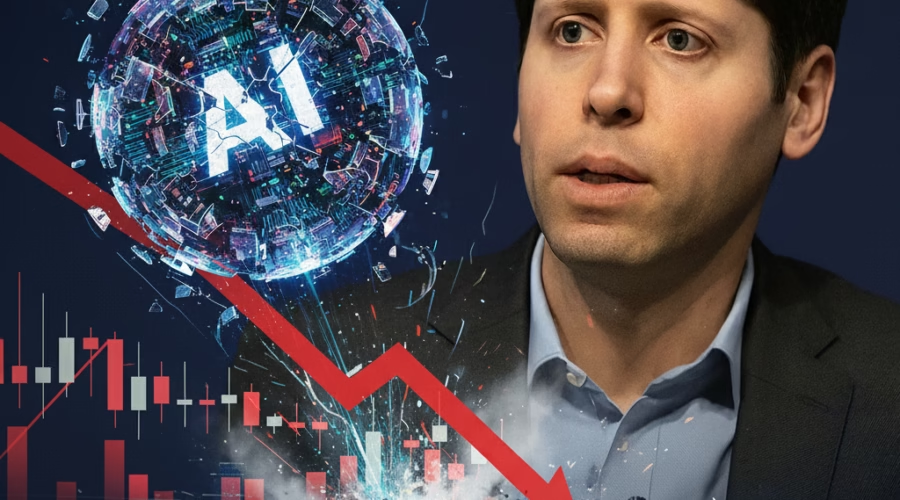
The timing of the controversy comes as the global tech industry debates whether artificial intelligence has entered a bubble phase. Altman himself recently warned that AI investments are beginning to mirror the excesses of the early 2000s dot-com boom. While AI technology continues to reshape industries, experts and business leaders have increasingly acknowledged that it still lacks true critical thinking and contextual understanding — the kind of reasoning that humans provide.
As more companies rush to train large language models, the costs of computing power, energy, and data have surged. These expenses, combined with long development cycles and limited near-term returns, have raised concerns that the economics of AI are becoming unsustainable.
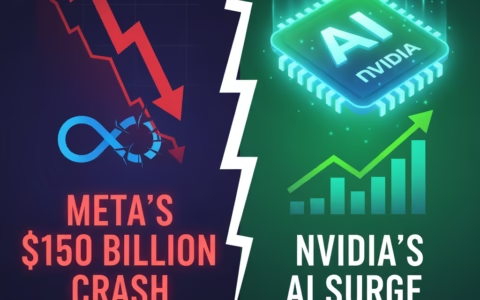
Meta Platforms, the parent company of Facebook and Instagram, has become a prime example of investor anxiety. The company’s shares fell sharply after it revealed that capital spending on AI infrastructure could exceed 70 billion dollars this year, with even higher spending planned for 2026. Investors were reminded of Meta’s earlier metaverse gamble, when large investments produced minimal returns and led to a major market selloff. Analysts now worry the same pattern could repeat if AI costs continue to rise without clear profits.
The AI investment surge has also highlighted several industry-wide risks. The most pressing is the monetization gap, where enormous infrastructure investments have not yet produced steady revenue. Building and training AI systems takes years, while the competition among companies grows by the month. Investor patience is wearing thin, and many are no longer swayed by announcements of “AI strategies” without proof of financial results. Moreover, even the most advanced AI systems can assist but not fully replace human decision-making, which limits their economic payoff in the short term.
The controversy has broader implications for India and the Asia-Pacific region. On one hand, global AI expansion has encouraged large data center projects and semiconductor investments in emerging markets. On the other hand, if the AI bubble deflates, developing economies could face a slowdown in capital inflows. India, which is positioning itself as a hub for AI infrastructure and chip manufacturing, may see both challenges and opportunities as the market adjusts. A pullback from global giants could open doors for more cost-efficient, innovation-driven Indian startups.
For OpenAI, Friar’s remark and Altman’s response highlight how fragile confidence has become in the AI sector. Any suggestion of government reliance can raise doubts about financial stability. Altman’s statement was as much a reassurance to investors as it was a declaration of independence from public support.
Across the tech landscape, the tone is shifting from exuberance to caution. The AI boom that defined the past two years may now be entering a more disciplined phase. Companies that balance ambition with efficiency are likely to survive the next market correction, while those driven purely by hype may face a reckoning.
Artificial intelligence remains one of the most important innovations of our time, but it is now being tested by financial reality. The OpenAI controversy and Meta’s spending backlash underline a simple truth: building AI capacity is not the same as building sustainable value. For investors and innovators alike, the challenge ahead is proving that AI progress can stand on its own, without government lifelines or investor overexcitement.