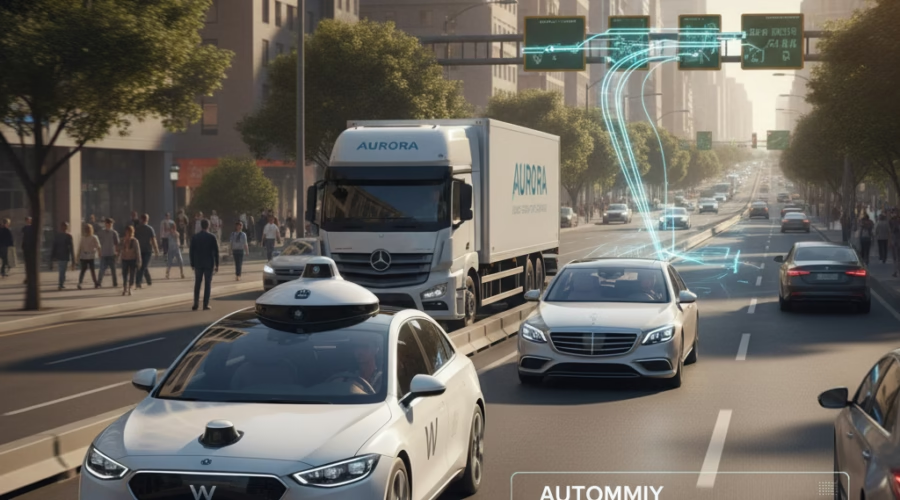
The global race toward self-driving cars has shifted from imagination to limited reality. In select cities like Phoenix, San Francisco, and Los Angeles, Waymo’s fully driverless robotaxis now operate daily within mapped zones. Riders can even hail these cars through Uber. In China, Baidu’s Apollo Go and companies like WeRide and Pony.ai are doing the same across multiple urban centers. These are genuine Level 4 autonomous services—vehicles that can handle night driving, intersections, and construction detours without human intervention, but only inside their geo-fenced areas.
On highways, self-driving trucks are quietly becoming the backbone of early adoption. Aurora has begun running driverless freight runs between Dallas and Houston, a milestone that’s expected to expand across the U.S. Southwest. Experts see highway freight as the most commercially viable use case for autonomy because highways are predictable and easier to map.
Consumer-level autonomy is progressing more cautiously. Mercedes-Benz’s Drive Pilot system is the first certified Level 3 autonomous feature available in both the U.S. and Germany. It allows drivers to take their hands and eyes off the road under specific conditions, such as during traffic jams. In Japan, Honda’s Traffic Jam Pilot offers a similar capability. Germany recently extended legal approval for Level 3 driving up to 95 kilometers per hour, with the UN now permitting systems up to 130 kilometers per hour where local laws allow.
Parking technology is another area seeing real-world adoption. Many new cars already park themselves or can be parked remotely using a smartphone. But Germany has gone further. At the Stuttgart airport, certain Mercedes models can perform fully driverless valet parking, using sensors built into the garage to find and park themselves—no human involvement required.
Tesla continues to play a high-profile but controversial role in the autonomy space. Its “Full Self-Driving (Supervised)” and Autopilot features remain officially classified as Level 2 driver-assist systems, requiring full human attention. The company has begun a small-scale robotaxi pilot in Austin, Texas, where vehicles operate in limited zones under close monitoring. Tesla’s approach is vision-based, relying on cameras and neural networks rather than lidar or high-definition maps. Critics argue this limits its reliability in complex environments. Despite CEO Elon Musk’s repeated promises of imminent autonomy, the company’s technology still requires driver supervision. Ongoing U.S. safety investigations, including by the National Highway Traffic Safety Administration, continue to examine crashes linked to its driver-assist features.
Globally, the U.S. and China are the clear leaders in large-scale autonomous deployment. Germany, Japan, and the United Kingdom are advancing through well-defined regulatory frameworks, with the U.K.’s Automated Vehicles Act allowing commercial no-driver pilots starting in 2026. China is pushing forward with massive demonstration zones and smart-road infrastructure, while the U.S. maintains tight oversight through the NHTSA and state-level permits.
Still, caution persists. General Motors’ Cruise division lost its California permits in 2023 after an incident in which a pedestrian was dragged by one of its driverless cars. Waymo faced a series of investigations in 2024 and 2025, including a recent probe involving a school bus stop. Despite this, independent studies show Waymo’s driverless vehicles experience up to 80 percent fewer injury-causing crashes than human drivers when operating within their designated zones.
The idea of “autonomous corridors” is also becoming a real-world concept. Michigan’s I-94 Connected and Automated Vehicle Corridor is being developed to connect Detroit and Ann Arbor with digital infrastructure for self-driving vehicles. Beijing’s autonomous driving zone integrates cloud-based traffic control, and Dubai has targeted 25 percent of all trips to be autonomous by 2030.
India’s path is slower but not stagnant. Startups like Minus Zero and Swaayatt have demonstrated driverless prototypes on Indian roads, while government bodies are updating automotive safety standards and exploring dedicated “smart corridors” for testing. However, without a unified national framework for autonomous vehicles, commercial deployment remains some years away.
Analysts see the late 2020s as a period of focused rollout rather than mass adoption. Between 2025 and 2027, more cities are expected to host geo-fenced robotaxi services and limited driverless trucking routes. By around 2030, broader Level 4 services could become commercially viable in developed markets, while widespread consumer adoption is expected closer to 2035 or beyond.
For now, autonomous vehicles are both a technological success and a logistical puzzle. Within their mapped boundaries, they are already safer than human drivers. But the challenge is scaling that safety to every street, climate, and traffic culture on earth. The journey toward full autonomy is no longer about proving that the technology works—it’s about proving that it can work everywhere, for everyone.