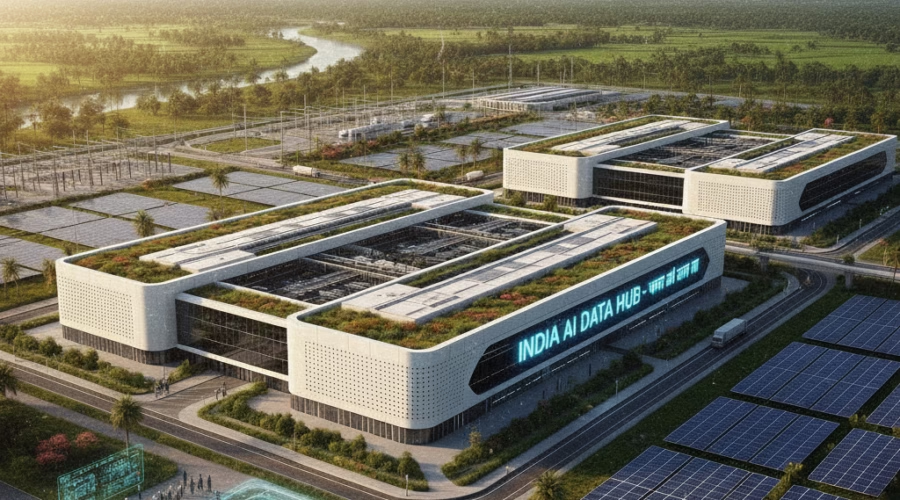
s the race to build artificial intelligence infrastructure intensifies, AI data centers are emerging as both economic catalysts and major energy consumers. While they promise jobs, investment and technological progress, they also strain local power grids and challenge sustainability efforts — forcing countries like India to rethink how far and how fast to expand.
Power-hungry machines reshaping the grid
AI data centers demand enormous amounts of electricity. A single large facility can consume as much power as a mid-sized town. When multiple centers cluster near major cities, they can account for anywhere between 2% to 5% of total urban electricity consumption — a figure expected to rise sharply as AI usage expands.
This surge means local governments and utilities must ramp up electricity generation and upgrade grids to prevent instability and blackouts. Unlike traditional industries, data centers require uninterrupted, high-quality power, along with advanced cooling systems that add further load on the grid.
Why electricity production must scale up
Electricity generation needs to grow for three primary reasons:
- Reliability: Continuous AI workloads mean any outage can cost millions. Data centers need consistent voltage and frequency stability.
- Infrastructure: Power must be transmitted efficiently to the sites, requiring new substations, high-capacity lines and reliable cooling water supplies.
- Cost management: Increased demand can raise local energy prices if supply doesn’t keep pace, affecting both consumers and industries.
The local economic equation
The construction and operation of data centers inject capital into local economies. They create thousands of jobs — from engineers and electricians to security and maintenance staff — and attract suppliers for power equipment, cooling systems and connectivity.
However, the benefits come with trade-offs. The same electricity and land that power data centers could have supported other industries. Higher electricity costs can ripple through to households and factories, creating political and economic pressure. And in regions where grids are already under strain, these centers can intensify the challenge of balancing industrial and domestic needs.
Industry voices raise the alarm
Technology leaders have begun warning about unchecked AI infrastructure expansion. Zoho founder Sridhar Vembu recently pointed out that a massive build-up of AI data centers could drive electricity bills far beyond affordability for developing countries. He cautioned that the cost of powering AI could become unsustainable for households and businesses, turning an innovation boom into a financial burden.
Vembu’s concern reflects a growing realization: AI progress is exciting, but the infrastructure powering it may not be economically or environmentally viable if growth continues unchecked.
The sustainability dilemma
Building too many AI data centers too quickly raises critical sustainability questions.
Most facilities still depend on conventional fossil-fuel power. Massive cooling requirements increase water consumption, while waste heat can affect local environments. Without clean energy integration, the net carbon footprint of AI infrastructure could undermine national climate goals.
Furthermore, the sheer pace of expansion risks overshooting local capacity, pushing grids toward instability and increasing electricity prices for the average consumer.
What an ideal AI data center strategy looks like
Experts agree that the path forward is not about stopping AI progress, but about managing it intelligently. The ideal strategy would include:
- Balanced growth: Focus on strategic locations with available renewable power and strong grid capacity, instead of building everywhere at once.
- Efficiency first: Invest in advanced chip architectures, AI workload optimization, and efficient liquid cooling to reduce total energy consumption.
- Clean power integration: Tie data centers to dedicated renewable sources — solar, wind, hydro or nuclear — supported by battery storage systems.
- Decentralized architecture: Adopt smaller, edge computing centers spread across regions, reducing transmission losses and local stress on grids.
- Transparent regulation: Require companies to report power usage, efficiency metrics and sustainability efforts, ensuring accountability.
A balancing act for the AI era
AI data centers are the new factories of the digital age — but their energy appetite demands smarter policy and planning. For developing economies like India, the challenge is to attract investment without compromising power reliability or affordability.
As the world’s digital infrastructure expands, governments and industry leaders must ensure that AI’s future doesn’t come at the cost of local sustainability. The goal should be an ecosystem where technology, economy and environment evolve together — not in competition.