Artificial intelligence may be transforming industries, but several of the world’s top technology leaders say it’s still far from replacing human talent.
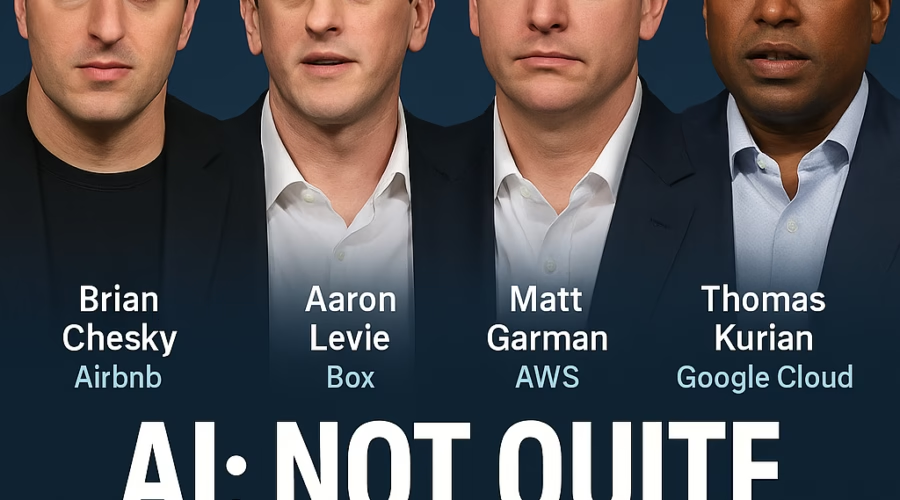
Airbnb CEO Brian Chesky recently said ChatGPT “wasn’t quite robust enough” for what the company wants to build, adding that he “didn’t think it was quite ready.” Airbnb has paused plans to integrate the chatbot directly into its platform. Chesky’s remark reflects a growing sentiment across Silicon Valley — that AI still lacks the nuance, empathy, and reliability needed for real-world human experiences.
Box CEO Aaron Levie offered a similar view, saying that fears of AI replacing workers are overstated. In an interview with Business Insider, Levie said, “AI automates tasks, not jobs.” He believes that if AI helps companies grow faster, it will create new roles instead of destroying them. “There are very few examples of entire sectors disappearing because of automation,” he said.
Amazon Web Services CEO Matt Garman was even more blunt, calling the idea of firing junior staff and replacing them with AI “the dumbest thing I’ve ever heard.” He said automation without mentorship harms future innovation. “You need to train and develop people — that’s how future leaders are made,” Garman told TechRadar.
Google Cloud CEO Thomas Kurian added his own caution, saying “AI is not going to replace you — it’s here to help you keep up.” Kurian noted that among Google Cloud’s enterprise clients, almost none have used AI to cut jobs. Instead, the technology has boosted efficiency and service quality.
A Reality Check from the Top
Across these statements runs a clear message: the leaders of companies building and deploying AI themselves are urging realism over hype.
Chesky’s “not ready yet,” Levie’s “augment, not replace,” Garman’s “don’t cut people,” and Kurian’s “assist, not eliminate” all highlight a shared understanding — that AI, for now, is a co-pilot, not a replacement.
Despite the rapid rise of generative AI since 2023, these systems still depend on human oversight, ethical reasoning, and contextual understanding. In other words, AI may be able to write a plan, but it can’t understand a business. It can draft an email, but not build a team.
Even in tech-driven industries, human creativity, empathy, and judgment remain irreplaceable. These comments from four influential CEOs show the industry moving beyond early euphoria toward a more grounded, mature phase of AI adoption.
Why It Matters
For professionals across industries, this growing consensus among top executives is reassuring: human skills still drive success.
While AI continues to evolve, creativity, collaboration, and problem-solving remain at the center of work. The world’s leading CEOs — not critics, but builders of AI ecosystems — are effectively saying that automation without human intelligence isn’t the future.
For policymakers and investors, this signals the start of a post-hype era — one focused on responsible integration rather than mass replacement.
The future of AI in the workplace, it seems, will be shaped not by machines replacing people, but by people learning to work smarter with machines.