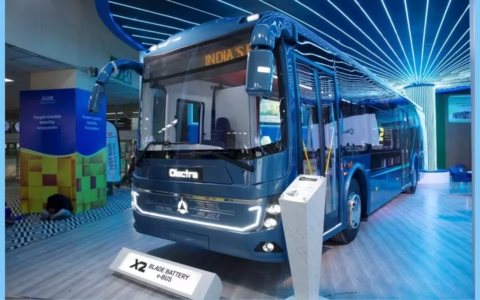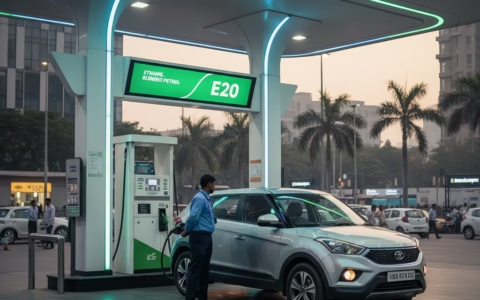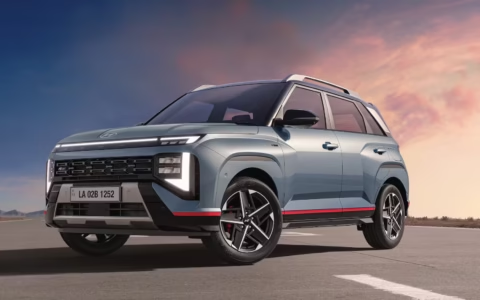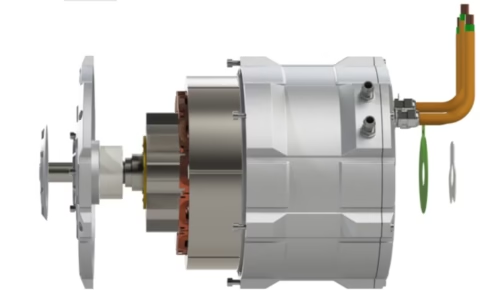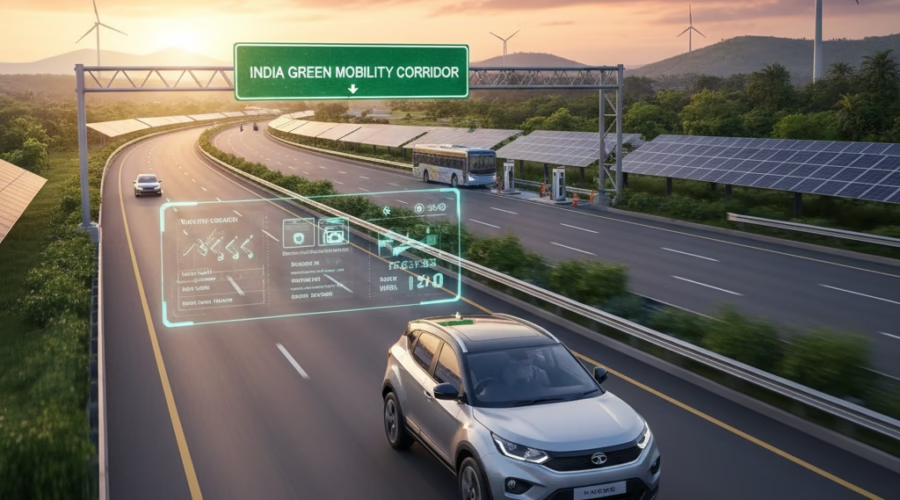
India’s automotive industry is entering a defining decade. As the world’s fifth-largest auto market accelerates toward a cleaner and smarter future, three forces are driving the change — electrification, software-defined vehicles (SDVs) and manufacturing for global exports. Together, they signal the rise of Auto 2.0, where mobility becomes as much about code and connectivity as it is about engines and steel.
Across the globe, cars are being reinvented as software platforms. Over-the-air updates, AI-based driver assistance and app-enabled services are turning vehicles into digital devices on wheels. Boston Consulting Group projects that nine out of ten new cars by 2029 will be software-defined, enabling constant feature upgrades and new revenue streams long after sale.
India is uniquely placed to ride this shift. The country’s auto-component industry, valued near $80 billion in FY 2025, is projected to reach $200 billion by 2030. Government initiatives such as FAME II and PLI schemes have triggered record investment in EV manufacturing, local battery plants and mobility software.
EV sales in India crossed three million units in FY 2025, a 45 percent jump from the previous year. Charging infrastructure now exceeds 12,000 stations nationwide. States such as Tamil Nadu and Gujarat are evolving into EV manufacturing zones. Falling battery prices are driving affordability, though supply-chain and charging-speed challenges remain.
While battery-electric vehicles dominate headlines, other technologies are advancing. Hydrogen fuel-cell vehicles (FCEVs) emit only water vapor, offering rapid refueling and long range, ideal for heavy-duty fleets. Automakers like Toyota, Hyundai and Honda are refining the technology, while India runs pilot hydrogen-bus projects. Experts see commercial adoption mainly after 2030, beginning with trucks and buses.
Battery innovation is the other frontier. Solid-state batteries promise higher energy density and faster charging, with limited rollout expected by 2028. Sodium-ion batteries could power low-cost EVs by early 2030s, reducing dependence on lithium. Meanwhile, vehicle-to-grid (V2G) systems will let EVs supply energy back to homes or utilities, creating new earning models for owners.
India’s EV momentum is powered by a handful of major brands. Tata Motors leads with its Nexon EV and Punch EV; Ola Electric dominates two-wheelers and plans to launch its first car by 2026. Mahindra is expanding the XUV400 EV and new Born Electric lineup. Among global entrants, BYD has grown rapidly, while Tesla is expected to begin local assembly in 2026. Together, these players command more than 80 percent of the EV market.
The opportunity extends far beyond vehicles. Component makers such as Bosch India, Motherson Group and Sundaram Clayton are adding software and export capabilities. Startups are targeting AI-driven diagnostics, energy analytics and battery-as-a-service platforms. For investors, this means the value chain is shifting from car sales to mobility platforms, data services and recurring digital revenues.
Challenges persist. Hydrogen and solid-state technologies remain expensive; rare-earth imports constrain battery supply; and cybersecurity risks will rise as cars become fully connected. Still, the direction is unmistakable — India is evolving from a vehicle manufacturer into a mobility-technology powerhouse.