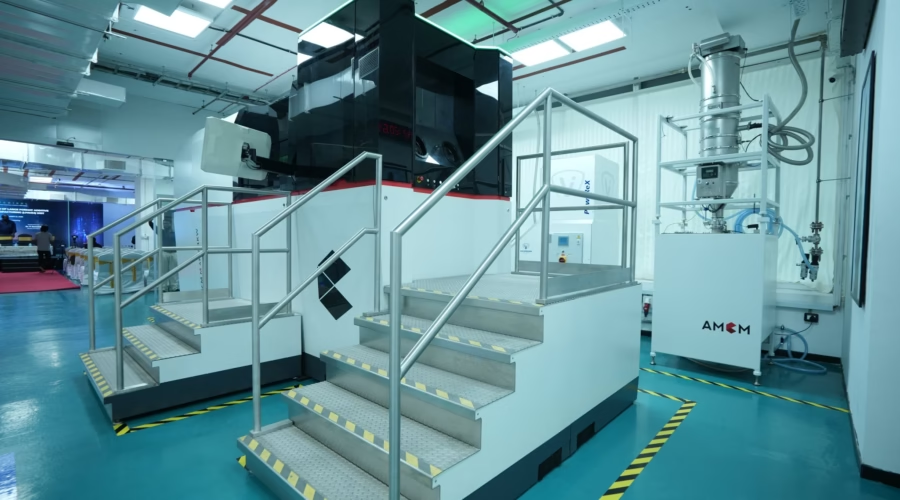
Chennai, India — Indian spacetech startup Agnikul Cosmos has expanded its manufacturing capabilities by commissioning the nation’s first large-format 3D printing facility for rockets. Launched in September 2025, the site is dedicated to aerospace and rocketry and is expected to transform how rockets are built in India.
The facility can 3D-print rocket components up to one meter in height, making it possible to build larger and more powerful engines. Agnikul says the innovation can reduce rocket manufacturing costs by up to 50 percent while cutting design-to-flight timelines from months to days. Engines produced here are capable of generating seven times the thrust of earlier designs, marking a significant leap for India’s private space industry.
Democratizing Access to Space
Founded in December 2017 by Srinath Ravichandran (CEO) and Moin SPM (COO), with Prof. Satyanarayanan Chakravarthy and Janardhana Raju, Agnikul Cosmos has been pioneering in the India private space race. Headquartered at the IIT Madras Research Park in Chennai, the company focuses on affordable small satellite launches in India by building customizable rockets.
Its flagship vehicle, the Agnibaan rocket, is a two-stage, highly customizable launch system designed to carry up to 100 kilograms to a 700-kilometer Low Earth Orbit (LEO). With flexibility at its core, Agnibaan is positioned as a solution for the growing global small-satellite market.
Track Record of Firsts
In under a decade, Agnikul has achieved several historic milestones for India’s private space sector:
- India’s first 3D-printed rocket engine: The Agnilet engine, a single-piece design, eliminated complex assembly and earned a U.S. patent.
- World’s first controlled flight powered by a single-piece 3D-printed engine: On May 30, 2024, Agnikul’s Agnibaan SOrTeD mission set global and national records. It was also India’s first semi-cryogenic engine rocket launch and the country’s first controlled ascent from a private launchpad in Sriharikota.
- Dhanush launchpad and mission control center: In November 2022, Agnikul became the first Indian private company to set up its own pad and mission control at Sriharikota, strengthening the ecosystem for private space companies in India.
- Collaboration with ISRO: In 2021, Agnikul signed a framework agreement with ISRO, gaining access to facilities and expertise critical for developing the Agnibaan rocket.
The Agnilet Engine: From Innovation to Scale
The Agnilet engine has been central to Agnikul’s breakthroughs in 3D printing in aerospace technology.
- Innovation (2020–2021): Designed as the world’s first fully 3D-printed, single-piece semi-cryogenic engine, Agnilet simplified manufacturing by integrating thrust chambers, injectors, and cooling channels in one unit.
- Validation (2022–2024): Following rigorous testing, the Agnibaan SOrTeD flight in 2024 marked the first controlled launch with a 3D-printed rocket engine. This flight provided validation data and secured Agnikul’s place in rocket history.
- Scaling (2025–present): With the large-format additive manufacturing facility, Agnikul is now capable of printing larger engines within days. This scalability enables flexible launch services for small satellites and reinforces India’s competitive position in space technology.
Why This Matters
The future of India’s private space sector is closely tied to small satellites, which are in demand for communications, Earth observation, and research. Traditional rocket manufacturing is expensive and slow, often limiting access for startups and research institutions.
By leveraging how 3D-printed engines reduce rocket costs, Agnikul is making space access more flexible and affordable. If the model succeeds, it could reduce dependence on foreign launch providers and position India as a global hub for rocket manufacturing innovation.