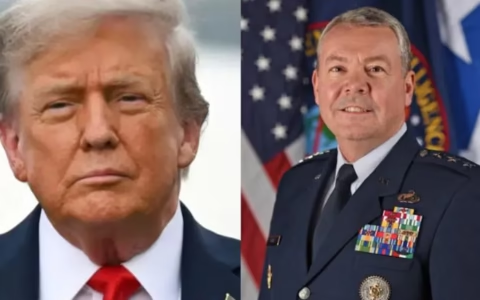
Will tariffs end after Trump leaves office in 2028? Experts warn both Republican and Democrat leaders are likely to keep U.S. trade wars alive.
Introduction: The Big Question on 2028 Tariffs
As Donald Trump begins what could be his final term as U.S. President, one question is on everyone’s mind: Will Trump’s tariffs finally end in 2028?
Businesses, global markets, and even U.S. voters are hoping that once Trump leaves office, the trade wars that defined his presidency will disappear too. But history and political reality suggest otherwise. Whether a Republican or a Democrat takes the White House in 2028, tariffs may remain a permanent fixture of U.S. trade policy.
What Are Trump Tariffs and Why Do They Matter?
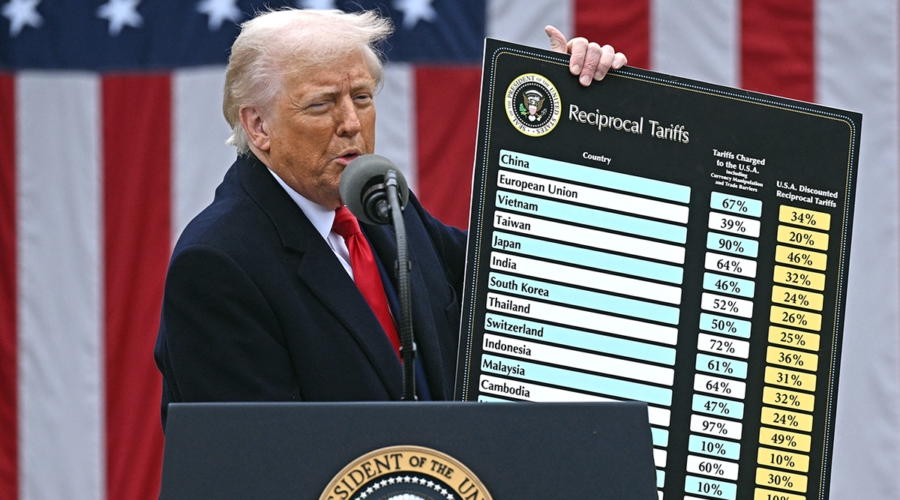
Trump tariffs refer to a series of import duties introduced during his presidency, targeting countries such as China, Mexico, Canada, the EU, and India.
These tariffs were designed to:
- Protect American industries (steel, aluminum, technology).
- Punish countries accused of unfair trade practices.
- Strengthen U.S. bargaining power in global trade negotiations.
While they energized Trump’s political base, they also triggered global retaliation, increased consumer costs, and unsettled supply chains worldwide.
Will Trump Tariffs End After 2028?
Here’s the uncomfortable truth: tariffs are unlikely to disappear, even after Trump.
The outcome depends largely on who wins in 2028. Let’s look at both scenarios.
Scenario 1: A Republican President in 2028
Trump remains the most dominant figure in American politics. By 2028, even though term limits prevent him from running again, his endorsement will shape the Republican candidate.
Names like J.D. Vance, Donald Trump Jr., or others from Trump’s circle are already floated as possible successors. Whoever it is, they’ll need to present themselves as a continuation of Trump’s policies—especially tariffs.
Why? Because:
- Republican voters view Trump’s tariffs as protecting American jobs.
- Any candidate seen as “soft” on trade risks alienating the party’s base.
- Tariffs are now central to the GOP identity, much like immigration and border security.
Even if a future Republican president tries to appear more stable or pragmatic, their trade policy will still resemble Trump’s. Symbolic outreach to minority voter groups or small adjustments may happen, but the core tariff agenda will remain intact.
Scenario 2: A Democrat President in 2028
What if Democrats retake the White House? Don’t expect big changes here either.
Look back at 2020: when Joe Biden replaced Trump, many assumed tariffs would be rolled back. Instead, Biden kept most of them in place. In fact, it wasn’t until the 2024 campaign season—when Trump pushed tariffs back into the spotlight—that the world even noticed how little had changed.
Why Democrats won’t reverse Trump tariffs in 2028:
- Rolling them back risks being seen as weak on China or foreign trade.
- Partial reversals may happen but will be used only as negotiating tools with allies.
- U.S. domestic politics now treats tariffs as a bipartisan weapon to protect industry.
In other words, even under a Democrat, tariffs may shrink at the edges, but they won’t disappear.
Why Tariffs Are Here to Stay
Several factors make it clear that Trump tariffs will outlast Trump himself:
- Republican Trifecta in Power
Currently, Republicans not only control the presidency but also the House of Representatives and Senate. This governing trifecta is rare and strengthens Trump-era policies. - Tariffs as a Political Weapon
Both parties have discovered that tariffs are politically popular with working-class voters, especially in industrial states like Michigan, Pennsylvania, and Ohio. - Lack of Alternatives
Neither party has presented a convincing trade strategy that moves away from tariffs. The result: tariffs are now the “default” setting in U.S. trade policy.
Global Impact of U.S. Tariffs Beyond 2028
The continuation of tariffs will affect multiple regions:
- China: Remains the primary target, with supply chains already diversifying.
- European Union: Steel, aluminum, and car exports will likely face ongoing barriers.
- India: Still recovering from the revocation of its Generalized System of Preferences (GSP) status under Trump.
- Mexico and Canada: Despite USMCA agreements, tariffs may return in disputes.
For businesses worldwide, this means uncertainty is the new normal.
FAQs: The Future of Trump Tariffs
1. Will Trump tariffs end in 2028?
Unlikely. Whether Republicans or Democrats win, tariffs will likely remain a key part of U.S. trade policy.
2. If a Republican wins, what happens to tariffs?
Expect continuation of Trump’s policies. A Republican candidate backed by Trump will double down on tariffs.
3. If a Democrat wins, will tariffs be reversed?
Only partially. Some symbolic rollbacks may occur, but tariffs will mostly stay in place as negotiation tools.
4. Why are tariffs so popular in U.S. politics?
Because they’re seen as protecting American jobs and punishing unfair trade practices, which resonates with both Republican and Democrat voters.
5. Which countries are most affected by U.S. tariffs?
China, EU nations, Canada, Mexico, and India remain the biggest targets of Trump-era tariffs.
Conclusion: 2028 Won’t End the Tariff Era
For those hoping 2028 will mark the end of the Trump tariffs, reality points in the opposite direction. Whether a Trump-backed Republican or a Democrat enters the White House, the global economy should prepare for a future where tariffs remain central to U.S. trade strategy.
The Trump presidency may end. The Trump tariffs probably won’t.