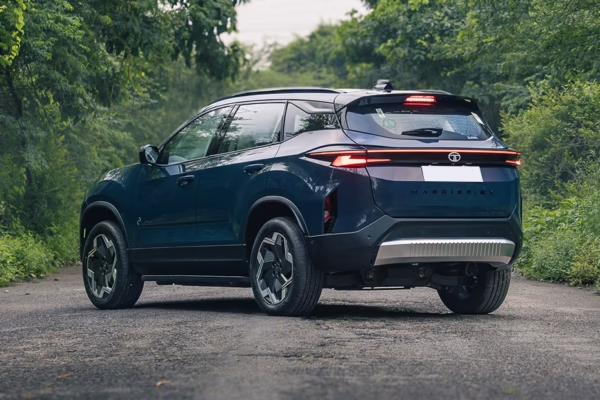
New Delhi, August 22, 2025 – The Indian automobile sector is currently dominated by widespread anticipation of a significant restructuring of the Goods and Services Tax (GST) framework, a move that could dramatically reduce vehicle prices and stimulate demand. This comes as the industry reports a mixed performance for the first quarter of the 2026 fiscal year, with robust export growth counteracting a subdued domestic market for passenger and commercial vehicles.
The government is actively considering a proposal to lower the GST rate on two-wheelers and small cars from the current 28% to 18%. Larger sedans and SUVs could also see a price drop, with the existing structure of 28% GST plus a 22% cess potentially being replaced by a flat 40% “sin tax”. A final decision from the GST Council is expected next month, and the prospect of lower taxes has already triggered a rally in automobile stocks.
However, the proposed GST changes have raised concerns within the burgeoning electric vehicle (EV) segment. A significant price reduction for internal combustion engine (ICE) vehicles could narrow the cost advantage currently held by EVs, which are taxed at a much lower 5% GST, potentially slowing down their adoption rate. Industry leaders, including the CEO of BMW India, have voiced the need for a tax structure that incentivizes cleaner technologies, including hybrids.
Q1 FY26 Performance: A Tale of Two Markets
According to a recent report by Axis Securities, the first quarter of the 2026 fiscal year (April-June 2025) presented a mixed bag for the Indian auto industry. While the domestic market for passenger and commercial vehicles remained largely subdued, the two-wheeler and tractor segments drove growth.
A significant highlight for the quarter was the strong performance in exports. Two-wheeler exports jumped by 23.2%, while passenger vehicle and commercial vehicle exports also saw sharp increases of 34.4% and 23.4% respectively. This export momentum, coupled with a revival in rural demand and a growing consumer preference for premium vehicles, has kept investor confidence high, with the BSE Auto Index outperforming the Sensex so far this fiscal year.
New Models on the Horizon
The Indian market is gearing up for a series of new vehicle launches. Renault is set to unveil the face-lifted version of its compact SUV, the Kiger, on August 24, 2025. Looking ahead to September, several key launches are anticipated, including the Maruti Suzuki e Vitara, the Tata Punch Facelift, the luxury Audi Q6 e-tron, and the Mercedes-Benz CLA Electric. Volvo is also expanding its EV portfolio with the upcoming launch of its smallest electric SUV, the EX30, with bookings set to open soon.
Electric Vehicle Sector Developments
The electric vehicle space continues to see dynamic growth and strategic moves. Vietnamese automaker VinFast has made a strong statement of intent by rapidly completing the construction of its manufacturing plant in Tamil Nadu, positioning the facility as an export hub for South Asia, the Middle East, and Africa.
Meanwhile, legacy luxury brands are deepening their EV focus. BMW, a leader in the premium EV segment in India, announced the expansion of its EV charging corridor across major national highways. In other news, TVS Motor Company has expanded its electric commercial vehicle lineup with the launch of the King Kargo HD EV.
Despite positive sales growth, as seen in states like Odisha where EV registrations have surged, the sector faces challenges related to financing and the absence of a mature used EV market. Fintech companies are reportedly exploring solutions to address these critical gaps.