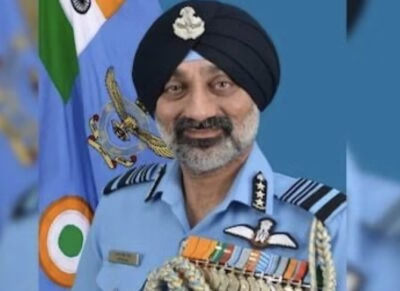
In a landmark disclosure that underscores the magnitude of India’s aerial operation earlier this year, Air Chief Marshal Amar Preet Singh officially confirmed that the IAF shot down five Pakistani fighter jets along with one large surveillance aircraft—likely an AEW&C (Airborne Early Warning & Control) plane—during Operation Sindoor last May.
This marks the first authoritative acknowledgment of Pakistani Air Force losses during the cross-border action launched on May 7, in retaliation for the deadly Pahalgam terror attack that claimed 26 civilian lives.
Key Highlights From IAF Chief’s Statement:
- The surveillance aircraft was neutralized at an astonishing range of approximately 300 km, marking it as “the largest-ever recorded surface-to-air kill.”
- The Russian-made S-400 air defence system played a pivotal role, shielding Indian airspace by deterring Pakistani aircraft and neutralizing long-range glide bomb threats.
- On the ground, the IAF struck multiple high-value targets: at Shahbaz Jacobabad airfield, half of an F-16 hangar was reportedly destroyed; at Bholari, another AEW&C platform and F-16s were targeted. Additional hits included command-and-control centers at Murid and Chaklala, as well as six radar installations.
More Than Just Jet Kills
While the downing of six Pakistani aircraft is seen as a significant tactical achievement, senior defence officials, including the Air Chief, stressed that India does not view the number of enemy jets destroyed as the ultimate measure of victory. Instead, the real success of Operation Sindoor lay in the strategic objectives set before the mission—neutralizing key Pakistani military infrastructure, degrading its aerial surveillance capabilities, and reasserting control over the air domain.
By those metrics, the IAF believes it accomplished its goals in the best possible way, with precision strikes, minimal collateral damage, and strong deterrence against further hostilities.
Political Fallout
The statement has put the Congress party on the backfoot, countering Opposition claims that Indian forces lacked operational freedom and suffered setbacks.
Meanwhile, Pakistan firmly denies any aircraft losses during the operation. Defence Minister Khawaja Muhammad Asif challenged India’s claims as “implausible” and demanded independent verification.
Context & Background
Operation Sindoor was a swift IAF offensive on May 7, targeting what India described as terrorist infrastructure in Pakistan and Pakistan-occupied Kashmir. Over the next three days, retaliatory fire and drone exchanges intensified until a ceasefire was declared on May 10.
Nearly three months later, Air Chief Marshal Singh’s public confirmation sheds light on the operation’s dual nature: delivering a psychological and operational blow to the Pakistani Air Force, while fulfilling India’s broader strategic aims without escalating into full-scale war.